2025

PUBLICATIONS : "Place-based Development as an Alternative to Infrastructure Mega-Projects: A Political Economy Perspective and Everyday Resistance in Ranong Province, Southern Thailand".

Publication Date : 30 December 2025

Author: Wipawadee Phanyangnoi

For further details on the article, visit the journal at

https://so01.tci-thaijo.org/index.php/eascramJ/article/view/282550

Abstract

Ranong Province, located in southern Thailand, is endowed with rich and diverse coastal and marine ecosystems, traditional economy reliant on artisanal fisheries, and a service sector rooted in eco-tourism and health-based industries, has been designated as a strategic site for national-scale infrastructure development. However, this top-down spatial designation reflects a development trajectory primarily shaped by macroeconomic imperatives, rather than by ecological, socio-economic, or cultural specificities of the area. Drawing from a political economy perspective, this trajectory reveals how centralized state planning privileges capital accumulation and investment-led growth while marginalizing local needs, knowledge, and livelihoods. Moreover, by incorporating the everyday politics, this paper highlights how local communities experience, contest, and negotiate development interventions in their daily interactions with state institutions and local's sociopolitical context. This paper advocates for a place-based development approach and place-sensitive strategies in shaping sustainable development trajectories for Ranong Province. Such an approach not only acknowledges local socio-ecological contexts but also recognizes the agency of subaltern actors in co-producing more just and equitable futures. The analysis is situated within broader concerns of community rights, spatial equity, and the capacity of local actors to meaningfully participate in defining their own development pathways.

PUBLICATIONS: "Leadership of Internationalisation at a Higher Education Institution in Thailand: Voices from Within".

Publication Date: 24 June 2025

Authors: Gwyn Peredur Evans

For further details on the article, visit the journal at

https://so04.tci-thaijo.org/index.php/swjournal/article/view/269418

Abstract

This study examines perceptions of the leadership of the internationalisation of one public higher education institution in Thailand. Based on documentary research and data from semi-structured interviews with senior leaders, lecturers and staff involved in 3 undergraduate international programmes (IP), it presents an analysis of the leadership dimensions which influence the progress of the internationalisation of higher education (IHE) of the institution in question. It situates the study within the dense global literature which addresses the strategies and factors considered crucial to effective IHE leadership, while addressing the unique local and cultural context of such an institution in Thailand. It concludes that while significant progress has been made in IHE by the institution in question, leaders should consider introducing greater clarity, inclusivity, and integration so that employees feel empowered and motivated to contribute towards, and ‘own’, the expansion of the internationalisation agenda. The study also determines that the dimension of ‘situation’ is paramount in terms of how leadership functions, and that bureaucracy, in particular, strongly influences leadership trends and models within the institution.

PUBLICATIONS: "Navigating the Ethical Maze: State Sovereignty, Human Rights, and the Complexities of Immigration Policy in a Globalized World".

Publication Date: 25 December 2025

Authors: Andrew Wai Phyo Kyaw

For further details on the article, visit the journal at

https://so05.tci-thaijo.org/index.php/polscicmujournal/article/view/277624

Abstract

This article examines the intricate ethical and political implications of immigration policies, underscoring the tension between state sovereignty and individuals' rights to mobility. It suggests that immigration policies strike a balance between national interests, human rights, and global economic conditions in a progressively interconnected world. The aim is to evaluate various viewpoints on immigration control, ranging from restrictive measures that prioritize national security and cultural integrity to more liberal policies that adhere to humanitarian ideals. Key insights reveal the paradox of globalization, where goods and information circulate freely while human movement faces restrictions; the clash between realist and idealist immigration policy approaches; the repercussions of events like 9/11 on the tightening of migration laws; and the ethical dilemmas in balancing state sovereignty with humanitarian responsibilities. The article concludes that immigration policies are shaped by a complex interplay of factors, including national identity, economic imperatives, security concerns, and ethical considerations. It highlights the ongoing challenge of balancing states' legitimate interests with the rights of immigrants.

PUBLICATIONS: "From Securitization to Weaponization The NGO Draft Act and the Criminalization of Non-state-led Development in Thailand".

Publication Date: 29 December 2025

Authors: Praween Van Rysselberge

For further details on the article, visit the journal at

https://so01.tci-thaijo.org/index.php/pegbuu/article/view/281931

Abstract

This article examines Thailand’s NGO Draft Act as part of a broader shift toward securitized governance and symbolic control of civil society. While framed as a regulatory reform, the Draft Act reinforces a legal environment where independent organizations face increased surveillance, compliance burdens, and discursive suspicion. Drawing on documentary research and critical discourse analysis, the article explores how terms like “public order”, “morality” and “foreign influence” function to recast NGOs as threats rather than development partners. Building on Laungaramsri’s critique of moral regulation and Bourdieu’s concept of symbolic power, the article argues that the Draft Act does not simply constrain civil society, it redefines its legitimacy through ideological alignment and procedural filtering. Rather than banning organizations outright, the law institutionalizes cautious self-regulation, narrowing civic space under the appearance of legal neutrality. By bridging securitization theory, autocratic legalism and symbolic power, the article shows how legal reforms can be deployed to criminalize dissent while preserving a façade of democratic order.

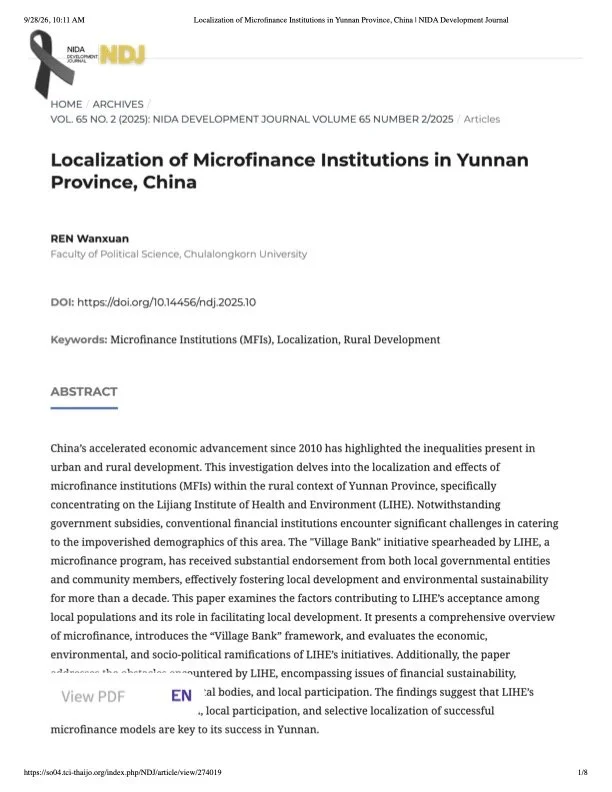
PUBLICATIONS: "Localization of Microfinance Institutions in Yunnan Province, China".

Publication Date: 11 November 2025

Authors: Ren Wanxuan

For further details on the article, visit the journal at

https://so04.tci-thaijo.org/index.php/NDJ/article/view/274019

Abstract

China’s accelerated economic advancement since 2010 has highlighted the inequalities present in urban and rural development. This investigation delves into the localization and effects of microfinance institutions (MFIs) within the rural context of Yunnan Province, specifically concentrating on the Lijiang Institute of Health and Environment (LIHE). Notwithstanding government subsidies, conventional financial institutions encounter significant challenges in catering to the impoverished demographics of this area. The "Village Bank" initiative spearheaded by LIHE, a microfinance program, has received substantial endorsement from both local governmental entities and community members, effectively fostering local development and environmental sustainability for more than a decade. This paper examines the factors contributing to LIHE’s acceptance among local populations and its role in facilitating local development. It presents a comprehensive overview of microfinance, introduces the “Village Bank” framework, and evaluates the economic, environmental, and socio-political ramifications of LIHE’s initiatives. Additionally, the paper addresses the obstacles encountered by LIHE, encompassing issues of financial sustainability, collaboration with governmental bodies, and local participation. The findings suggest that LIHE’s emphasis on self-organization, local participation, and selective localization of successful microfinance models are key to its success in Yunnan.

PUBLICATIONS: "Navigating Liminal Legality: Vulnerabilities of Urban Refugees and Asylum Seekers in Thailand".

Publication Date:June 2025

Authors: Andrew Wai Phyo Kyaw

For further details on the article, visit the journal at

https://jcsh.rsu.ac.th/volume/12/number/1/article/251

Abstract

This article examines the vulnerabilities of Thailand's urban refugees and asylum seekers under existing laws and legal mechanisms. Despite hosting approximately 5,500 urban refugees and asylum seekers from over 40 countries, Thailand is not a signatory to the 1951 Refugee Convention and its 1967 protocol. The country's response to people seeking refuge is primarily governed by domestic laws, leaving urban refugees and asylum seekers vulnerable to arrest, detention, and limited access to basic services. The recently established National Screening Mechanism (NSM) in 2019 aims to differentiate between migrant workers and asylum seekers, who are granted 'Protected Person' status. However, this study reveals that the existing framework falls short in key critical areas, potentially exacerbating the vulnerabilities of those it intends to safeguard. Through qualitative research methods, including in-depth interviews with 20 urban refugees and asylum seekers in Bangkok, this article explores their experiences and interactions with Thai law enforcement, immigration procedures, and daily survival strategies. The findings highlight interconnected vulnerabilities, including legal barriers to employment, subjection to exploitation, racial profiling, and procedural challenges to accessing justice. Drawing on the notion of "liminal legality" suggested by Cecilia Menjiver to understand the precarious existence of urban refugees and asylum seekers in Thailand, this article illustrates how urban refugees and asylum seekers live in a paradoxical area where they are both legally invisible and physically present, which leaves them vulnerable and in a condition of constant uncertainty. It concludes that Thailand's approach to refugee protection must be revisited holistically and address legal, policy, and practical issues to create a more effective, humane, and rights-based protection system aligned with international standards.