2023

PUBLICATIONS: "Migrant Worker Networks and Roles in Community Development through Resource Transfers".

Publication Date : 13 August 2023

Author: Kamonwan Roengsumran

For further details on the article, visit the journal at

https://www.journal.nu.ac.th/JCDR/article/view/Vol-16-No-3-2023-97-114

Abstract

The purpose of this paper is to examine the roles of migrant worker networks in community development through the transfer of resources in the context of Samut Sakhon province. Despite disagreement over whether resource transfers across the country facilitate or thwart development (see Bartram et al., 2014), this study claims that transactions of money and knowledge, practices, and values—particularly in the destination country— can lead to community development, and that migrant networks can be counted among development actors that engage in the process of transferring resources. This study focuses on the process of resource transfers in the destination country. To understand the roles of migrant worker networks in transferring resources in Samut Sakhon province, online surveys were conducted with 94 participants, in-depth interviews conducted with 6 Mon migrant workers, and semi-structured interviews were conducted with 5 community leaders or individuals working for Mon groups. This study’s findings demonstrate that Mon migrant worker networks are engaged in the process of transferring resources through donations to network members and to Mon self-help group projects promoting Buddhism and providing for basic needs (i.e., education, food security during the COVID-19 pandemic, etc.) and through the provision of education. Furthermore, close ties (family and friends) and organizational ties (Mon self-help groups) are engaged in sharing information, knowledge, perceptions, and experiences within networks. Joining and collaborating with Mon self-help groups and participation in community activities are kinds of an engagement in the process of resource transfers seen in this context. Trust is a significant factor that encourages migrant workers to transfer resources within their networks. Actions of engaging in the process of resource transfers built on trust benefit the community and bring about community development in the destination country, since those actions’ outcomes represent a high level of agency and strengthened solidarity, as following Bhattacharyya’s (1995) community development perspective. Donation for religious-related projects, joining and working for Mon self-help groups and participating in community events/activities lead to strengthened solidarity due to shared interests being strengthened, while donation for promoting education, the provision of education and sharing the perceptions, experiences, knowledge, etc. within the migrant worker networks lead to a high level of agency because of migrant workers’ increasing capability indicated by their better job opportunity and income. However, when creating conditions conducive to community development, a balance between solidarity and agency is necessary.

PUBLICATIONS:"Exploring the Factors Influencing Resource Transfers among Mon Migrant Worker Networks in Samut Sakhon Province, Thailand'.

Publication Date : 28 December 2023

Author: Kamonwan Roengsumran

For further details on the article, visit the journal at

https://so03.tci-thaijo.org/index.php/sduhs/article/view/274235

Abstract

Resource transactions occur within Mon migrant worker networks through the sharing of different kinds of support. However, the flow of resources can be influenced by a range of factors that promote or impede the capacity of members of migrant networks to transfer resources. This paper examines the factors influencing the process of resource transfers among co-ethnic migrant worker networks in the
context of Samut Sakhon Province, Thailand. This study was conducted from December 2021 to April 2022 in Amphoe Meaung (Samut Sakhon’s capital district), Samut Sakhon Province. Samut Sakhon Province was selected as the study site due to an existence of supportive networks of co-ethnic migrant workers providing financial and social support to their close ties and organizational ties. A large number of Mon migrant workers (see also Baonerd, 2007a: 9; Baonerd, 2007b:5) and many Thai- Mon people with Thai ID cards which embrace shared ethnic identity and characteristics represent the co-ethnic Mon migrant worker networks— the scope of this study. This study applies a mixed- method approach, using the
quantitative research method for finding the frequency of migrant workers’ characteristics and behaviours of resource transfers and the qualitative research methods with interpretative phenomenological analysis (IPA). Through the snowball technique, in- depth interviews were conducted with six Myanmar migrant workers (Mon ethnicity), and semi-structured interviews were conducted with five non-migrant community leaders or employees of Mon groups to gain insights into the factors influencing resource transfers in Samut Sakhon Province. Online surveys were also conducted randomly with a wide range of 94 respondents living in several communities in Samut Sakhon Province to enable validation of qualitative
data collected for this study. Data about factors affecting the transfer of resourceswere collected by using the online survey method. The use of qualitative research methods led to rich data to support these points. This study’s findings demonstrates that factors promoting the flow of resources included social and cultural circumstances (e.g., the COVID- 19 pandemic, collective cultural values), roles and
leadership within the group, socialization, and internet and social media. Factors hindering the flow of resources included the COVID-19 pandemic restrictions, and regulations and controlling systems, power relations within co-ethnic migrant networks resulting from migrants’ limited access to resources and opportunities. An acknowledgement about factors promoting and impeding resource transfer can
prevent obstacles of the resource flows, while maintaining and increasing the flow of resources within Mon migrant worker networks in methods that fully benefit migrant workers.

PUBLICATIONS: "What does the multiverse of practical development look like? A case study of alternative farming communities in northeastern Thailand".

Publication Date : 28 December 2023

Author: Thita Orn-in

For further details on the article, visit the journal at

https://so03.tcithaijo.org/index.php/jla_ubu/article/view/267618

Abstract

The 'Pluriverse' theory challenges the concept of a one-dimensional world for development, making it a popular topic in discussions about development alternatives to create a 'multi-planetary world' that embraces diverse developmental well-being and co-existence, rather than a linear, human-centered economic growth model based on imperialism, capitalism, and modernity. This research aims to bridge empirical data with theory by studying alternative agricultural communities in Sisaket Province, Thailand.

 This research comprises three case studies: Srisaket Asok Village, a village practicing sustainable agriculture based on Buddhist ethical principles; the Khon Tham Association, a group affected by the construction of the Rasi Salai Dam and their struggle to live in the riparian forest, along with a network of agroecology movements; and Rai Thong Organic Farm, a social enterprise working with farmers to enhance the production of organic rice to meet global market standards. The research suggests that these case studies, focusing on alternative agriculture based on ideals and aspirations within the context of Thai agriculture, create friction and lead to assimilation into modernity, represented here by the state, profit, and modern scientific knowledge. This is due to the socio-political and cultural contexts of the case studies. While not necessarily demonstrating extreme transitions, this pluralism represents a path towards the realization of the concept of a Pluriverse, as the clash of complex alternative development discourses leads to a middle ground. This research aims to contribute to increasing knowledge about the pluriverse of development in practice to enhance international debate.

PUBLICATIONS: "Governmentality in the Context of a Japanese-funded Farm-to- Market Road (FMR) in Agdangan, Quezon Province, Philippines".

Publication Date : 2023

Author: Josephine Therese Emily Teves

For further details on the article, visit the journal at

http://publications.tlu.ee/index.php/stss/article/view/1023

Abstract

Recent studies have focused on the role of Official Development Assistance (ODA) in financing infrastructural projects and rural development programmes. This study contributes to this literature by demonstrating how Japanese and Filipino aid authorities facilitate a Japanese-ODA-funded Farm-to-Market Road (FMR) subproject as a solution aiming to achieve overall poverty reduction and rural economic growth in the Philippines. Drawing on Foucault’s governmentality, the paper analyses processes and interactions within the management stages of the FMR subproject. It examines the impact of the completed FMR among agrarian reform beneficiaries (ARBs). It argues that while the FMR fostered mutual understanding and beneficial relationships among aid authorities, more significant advantages were accrued by the non-poor sector. Consequently, ARBs clamour for further support to maximize FMR benefits.

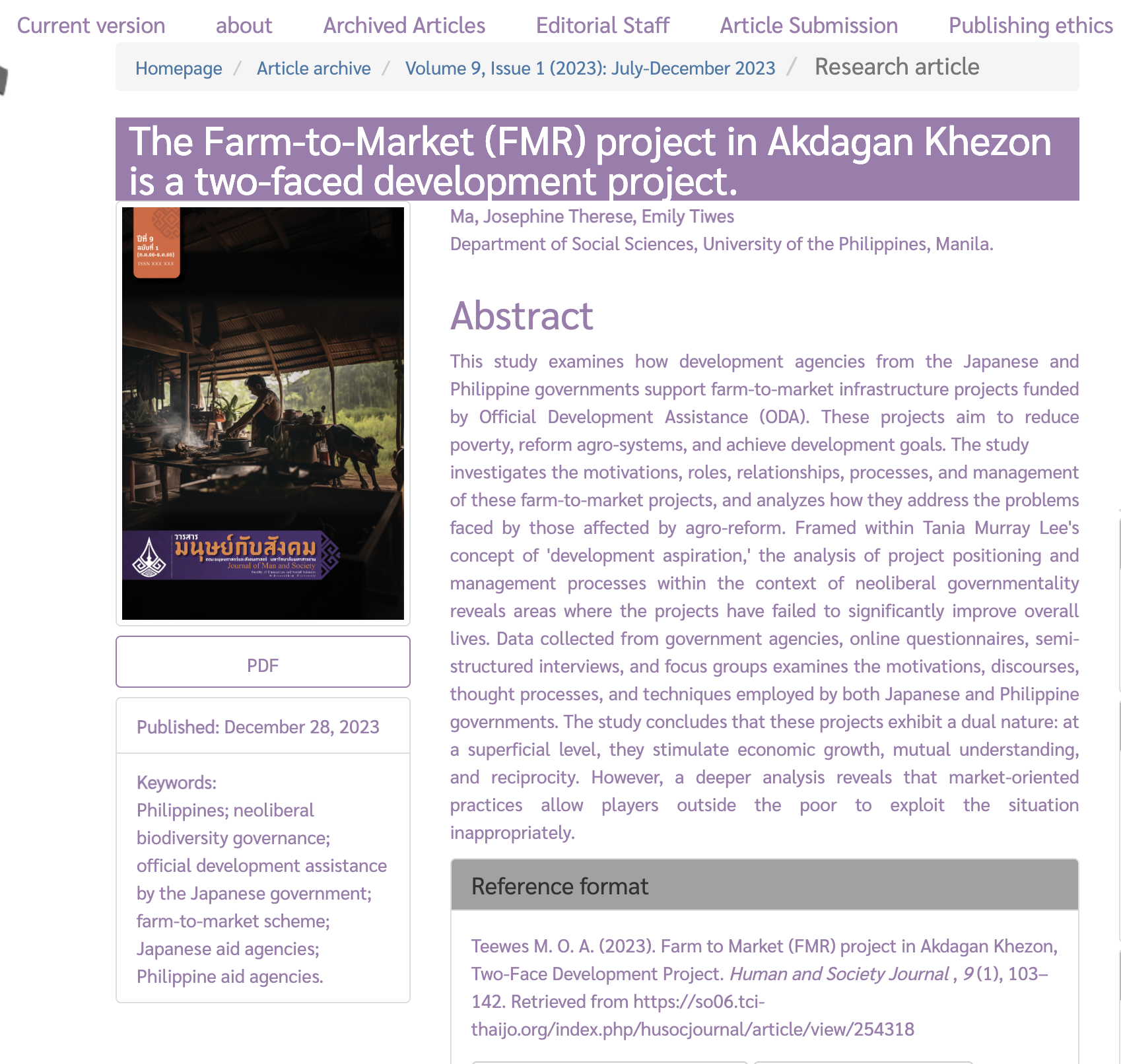
PUBLICATIONS: "The Farm-to-Market (FMR) project in Akdagan Khezon is a two-faced development project".

Publication Date: 28 December 2023

Author: Josephine Therese Emily Teves

For further details on the article, visit the journal at

https://so06.tci-thaijo.org/index.php/husocjournal/article/view/254318

Abstract

This study examines how development agencies from the Japanese and Philippine governments support farm-to-market infrastructure projects funded by Official Development Assistance (ODA). These projects aim to reduce poverty, reform agro-systems, and achieve development goals. The study investigates the motivations, roles, relationships, processes, and management of these farm-to-market projects, and analyzes how they address the problems faced by those affected by agro-reform. Framed within Tania Murray Lee's concept of 'development aspiration,' the analysis of project positioning and management processes within the context of neoliberal governmentality reveals areas where the projects have failed to significantly improve overall lives. Data collected from government agencies, online questionnaires, semi-structured interviews, and focus groups examines the motivations, discourses, thought processes, and techniques employed by both Japanese and Philippine governments. The study concludes that these projects exhibit a dual nature: at a superficial level, they stimulate economic growth, mutual understanding, and reciprocity. However, a deeper analysis reveals that market-oriented practices allow players outside the poor to exploit the situation inappropriately.

PUBLICATIONS: "Beyond Non-Interference: The Improved ASEAN Humanitarian-assistance Mechanism to Respond to the Myanmar Crisis".

Publication Date: 07 February 2023

Author: Haosheng Duan, Yunkang Liu

For further details on the article, visit the journal at

https://so06.tci-thaijo.org/index.php/asi/article/view/254879

Abstract

Since the occurrence of the Myanmar military coup in February 2021, the non-interference principle of the ASEAN Way shows the institutional limitations in dealing with the Myanmar crisis effectively. Simultaneously, some ASEAN scholars suggest that ASEAN may need to improve the regional human-rights mechanism to resolve the crisis by practicing Responsibility to Protect (R2P). Nevertheless, the Myanmar crisis is being trapped in an anarchic political environment, different attitudes of ASEAN and Myanmar toward the crisis not only expanded the conflicts between non-interference and R2P, and resulted in the lack of a synergistic mechanism to cope with this crisis. To solve practical problems, meet the needs of the Myanmar people for humanitarian assistance and alleviate the ripple effects originating from the Myanmar crisis in neighboring countries, this article adopts constructivism of international relations (IR) and the theory of functional synergism to analyze the different attitudes to non-interference and R2P among the region, as well as proposes a strategy of constructing a new synergistic humanitarian-assistance mechanism that beyond the limitations of non-interference to dealing with the Myanmar crisis.

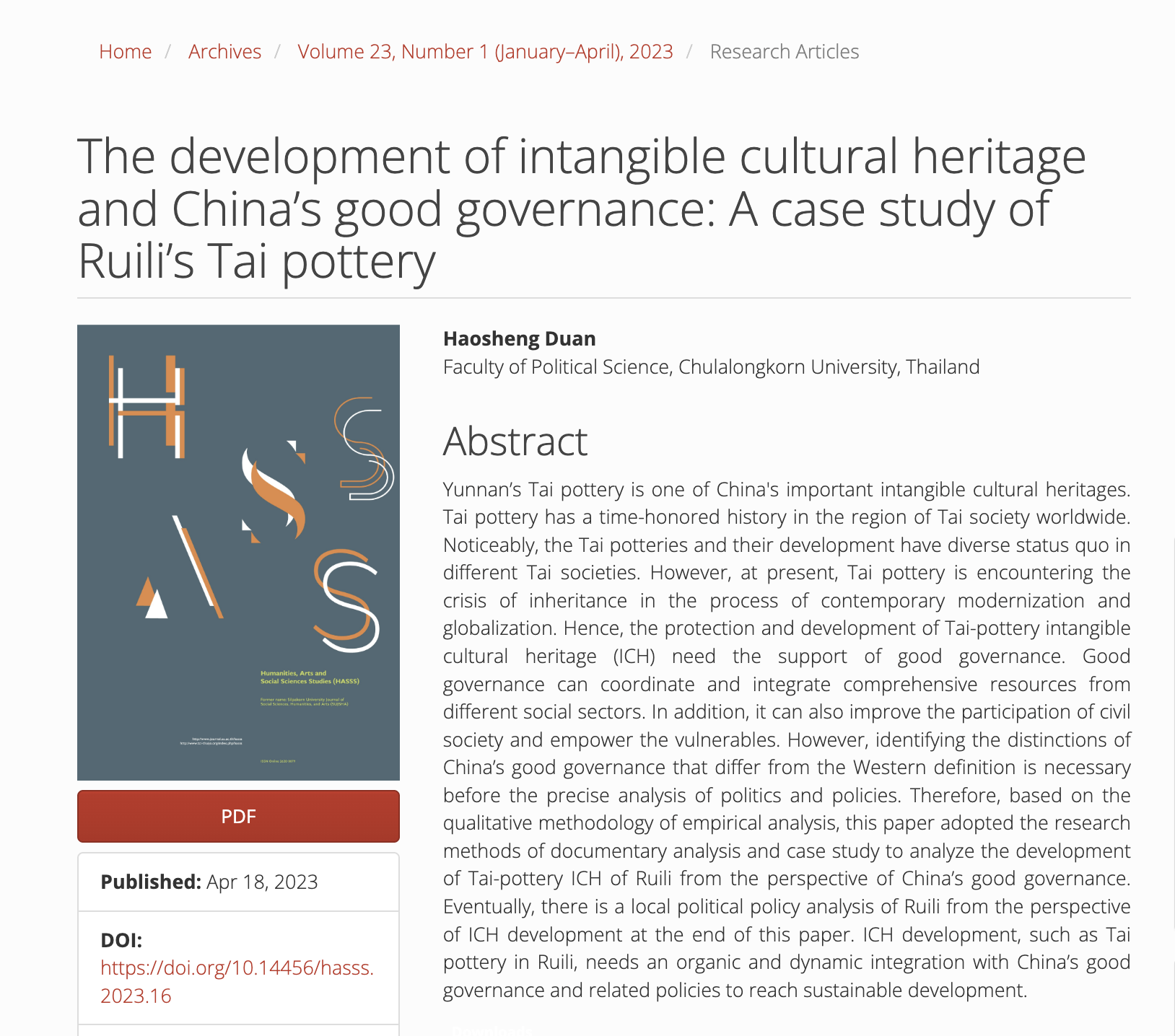
PUBLICATIONS: "The development of intangible cultural heritage and China’s good governance: A case study of Ruili’s Tai pottery".

Publication Date: 24 April 2023

Author: Haosheng Duan

For further details on the article, visit the journal at

https://so02.tci-thaijo.org/index.php/hasss/article/view/262269

Abstract

Yunnan’s Tai pottery is one of China's important intangible cultural heritages. Tai pottery has a time-honored history in the region of Tai society worldwide. Noticeably, the Tai potteries and their development have diverse status quo in different Tai societies. However, at present, Tai pottery is encountering the crisis of inheritance in the process of contemporary modernization and globalization. Hence, the protection and development of Tai-pottery intangible cultural heritage (ICH) need the support of good governance. Good governance can coordinate and integrate comprehensive resources from different social sectors. In addition, it can also improve the participation of civil society and empower the vulnerables. However, identifying the distinctions of China’s good governance that differ from the Western definition is necessary before the precise analysis of politics and policies. Therefore, based on the qualitative methodology of empirical analysis, this paper adopted the research methods of documentary analysis and case study to analyze the development of Tai-pottery ICH of Ruili from the perspective of China’s good governance. Eventually, there is a local political policy analysis of Ruili from the perspective of ICH development at the end of this paper. ICH development, such as Tai pottery in Ruili, needs an organic and dynamic integration with China’s good governance and related policies to reach sustainable development.

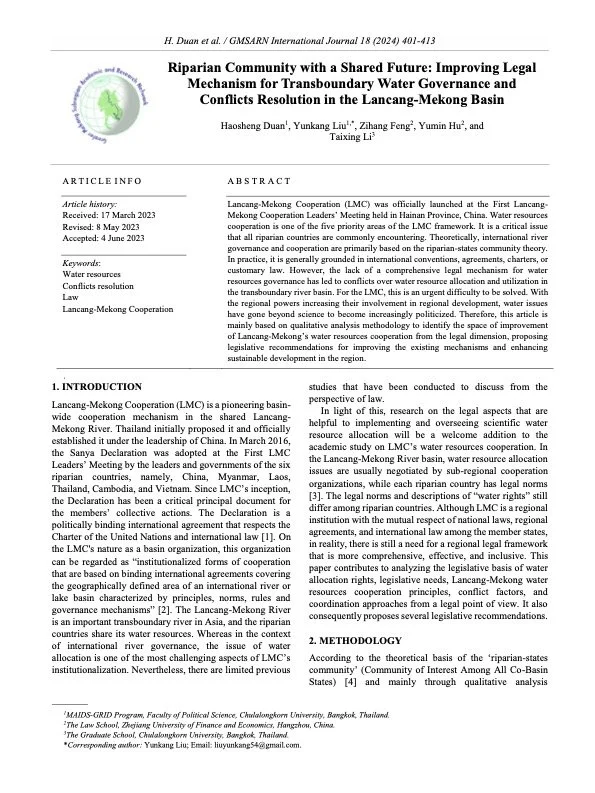
PUBLICATIONS: "Riparian Community with a Shared Future: Improving Legal Mechanism for Transboundary Water Governance and Conflicts Resolution in the Lancang-Mekong Basin".

Publication Date: 4 June 2023

Author: Haosheng Duan, Yunkang Liu, Zihang Feng , Yumin Hu, and Taixing Li

For further details on the article, visit the journal at

https://gmsarnjournal.com/home/wp-content/uploads/2023/12/vol18no3-14.pdf

Abstract

Lancang-Mekong Cooperation (LMC) was officially launched at the First LancangMekong Cooperation Leaders’ Meeting held in Hainan Province, China. Water resources cooperation is one of the five priority areas of the LMC framework. It is a critical issue that all riparian countries are commonly encountering. Theoretically, international river governance and cooperation are primarily based on the riparian-states community theory. In practice, it is generally grounded in international conventions, agreements, charters, or customary law. However, the lack of a comprehensive legal mechanism for water resources governance has led to conflicts over water resource allocation and utilization in the transboundary river basin. For the LMC, this is an urgent difficulty to be solved. With the regional powers increasing their involvement in regional development, water issues have gone beyond science to become increasingly politicized. Therefore, this article is mainly based on qualitative analysis methodology to identify the space of improvement of Lancang-Mekong’s water resources cooperation from the legal dimension, proposing legislative recommendations for improving the existing mechanisms and enhancing sustainable development in the region.