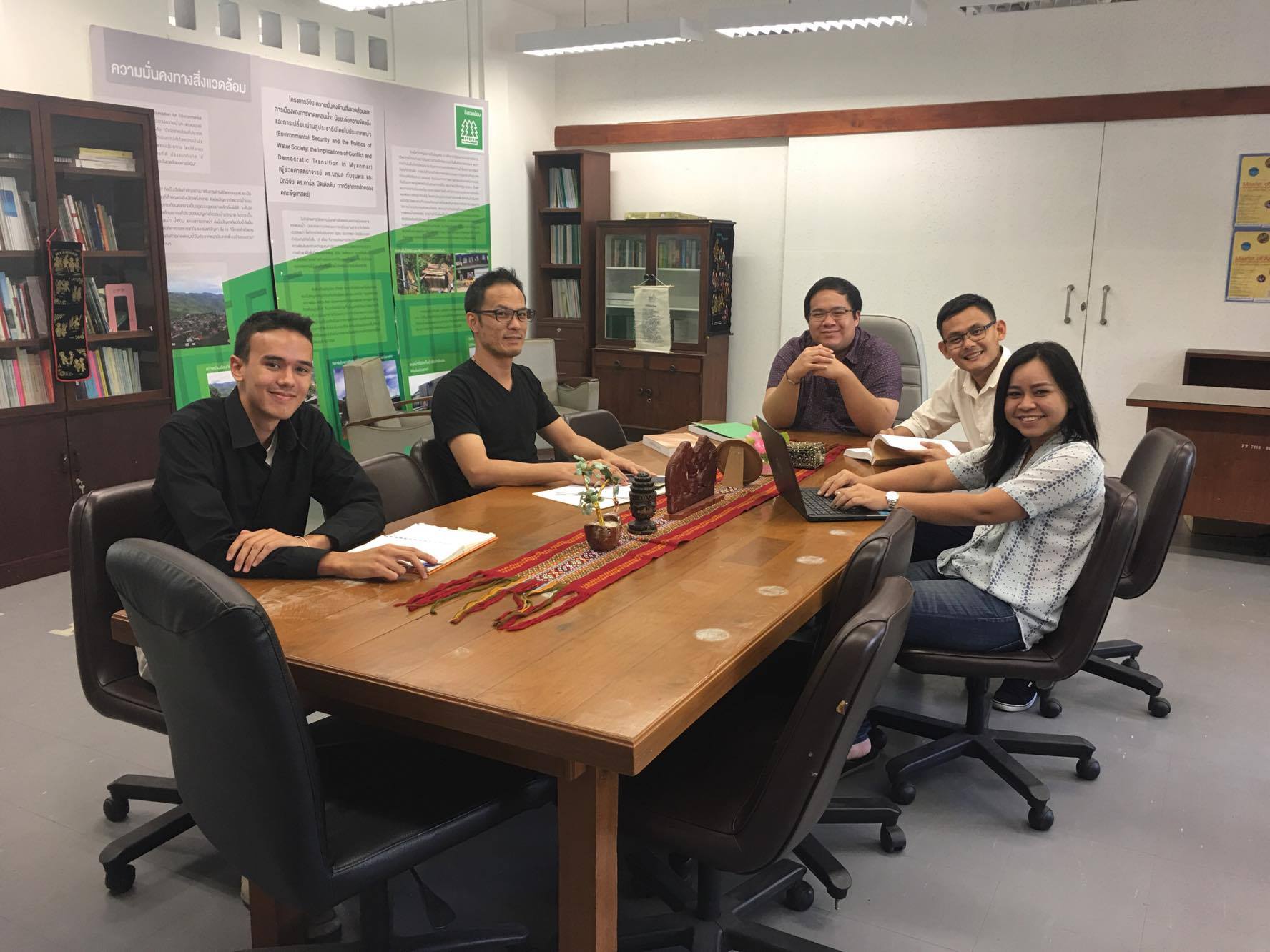
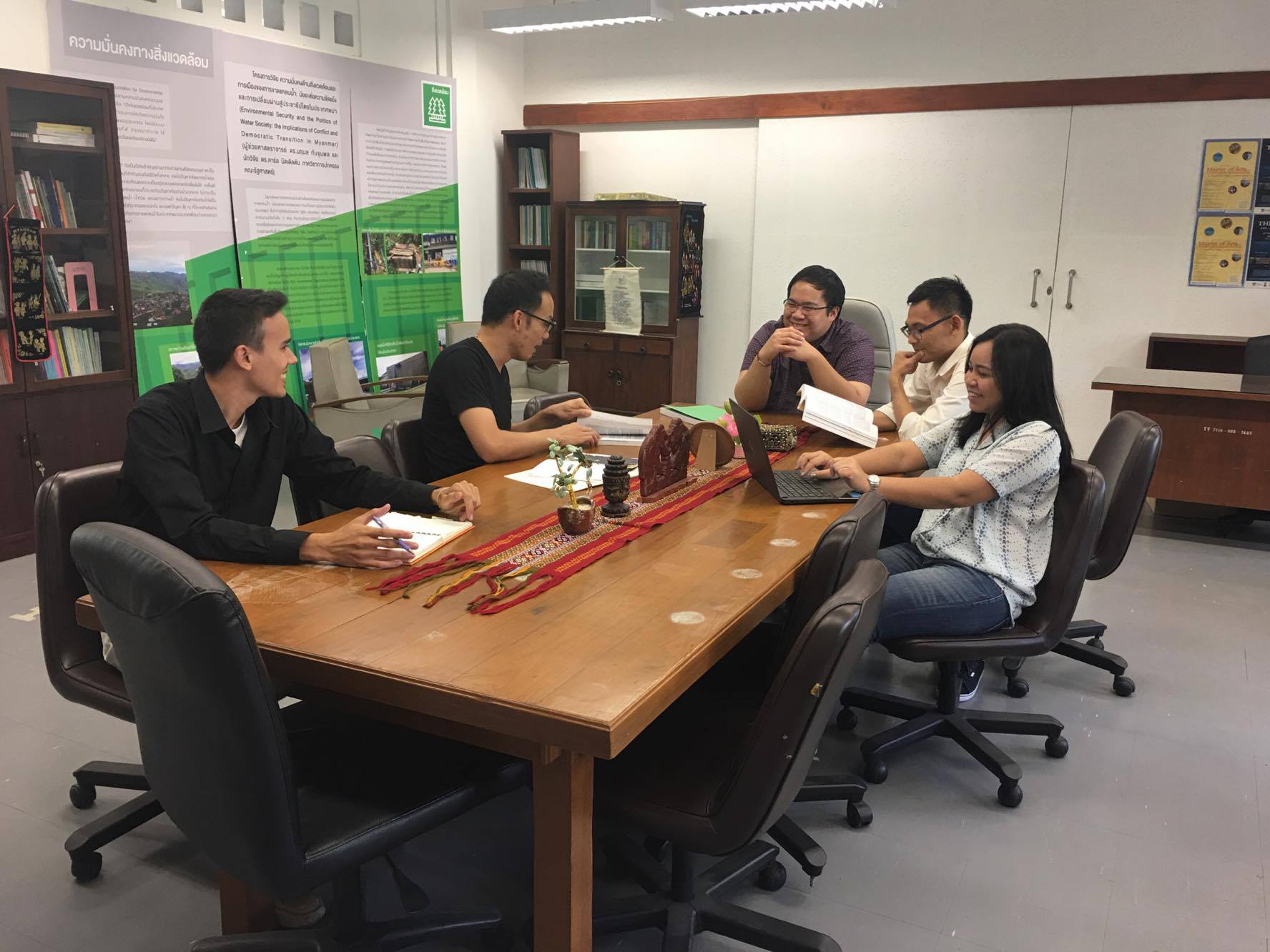
UPCOMING PUBLIC SEMINAR: "Water Scarcity and Disaster Recovery in Hakha Town, Chin State, Myanmar: Technical Problem or Governance Challenge? [5 July 2017]

download.jpg

14:00-16:00, Alumni Meeting Room, 12th Floor, Faculty of Political Science, Chulalongkorn University

Co-organized by the Center for Social Development Studies (CSDS) and the Master of Arts in International Development Studies of the Faculty of Political Science Chulalongkorn University.

This event will be broadcast on Facebook live: www.facebook.com/CSDSChula/

Introduction

Hakha town is the capital of Chin State, Myanmar, located in the mountainous Northwest of the country. Chin State is one of the poorest states in Myanmar, including in terms of economy, basic infrastructure, and access to health care and education. This reflects a lack of long-term investment in basic services, as well as being the product of Myanmar’s long-standing conflict.

In recent years, the town’s population has faced growing water insecurity. This has created great hardships for the local population, especially in the dry season. For those who cannot access water from private springs, or afford to buy water, they must queue sometimes for hours to collect relatively small amounts of water. This situation has caused discontent towards the Municipal, State and Union level government, and has also on occasion caused conflict amongst the local population themselves.

Compounding the difficulties faced by Hakha’s population, in June 2015, Hakha town suffered a major landslide. As a result, over 4000 people living in at-risk places were moved, many permanently to a new settlement. In the settlement, the government has provided land or houses, yet basic services including water and schools were lagging behind. In the longer-term, the resettled people, who are mostly farmers, are uncertain about how they can make a living without access to farming land, and a perceived limited support from the government.

Research presented at the seminar will show how water insecurity is the product of physical, social and political processes that are inter-related, including: rising water demand due to a growing population without systematic town planning; deforestation of the surrounding watershed which has reduced water supply; and underinvestment in water supply infrastructure. The seminar will explore the underlying causes of these dynamics, as a basis for deliberating approaches to ensure equitable and reliable water access for all of Hakha’s residents.

Seminar speakers

  • “Water insecurity in Hakha Town, Chin State, Myanmar” by Asst. Prof. Dr. Carl Middleton (Director of CSDS) and Orapan Pratomlek (CSDS project coordinator)
  • “Prospects for improved water security: Municipal water, watershed protection, and urban planning” Van Bawi Lian (CSDS researcher)
  • “Lessons learned from landslide disaster recovery in Hakha town, and how to strengthen resilience” by Hlawn Tin Cuai (Master Student of Architecture (IMARCH), Faculty of Architecture, Chulalongkorn University; and ex- Operation Manager of Hakha Rescue Committee, September 2015 to February 2016)
  • Discussant: Pastor Lai Cung (Hakhathar Baptist Church)
  • Chair: Asst. Prof. Dr. Naruemon Thabchumpon (Director of MAIDS Program, Faculty of Political Science, Chulalongkorn University)
  • Opening remarks: Assoc. Prof. Dr. Ake Tangsupvattana, Dean of Faculty of Political Science, Chulalongkorn University (t.b.c.)

For further details on CSDS’s research on Water governance and access to water in Hakha Town, Chin State, Myanmar, visit here: http://www.csds-chula.org/water-security-in-hakha/

This research is supported by Chula UniSearch under the Human Security Cluster. 
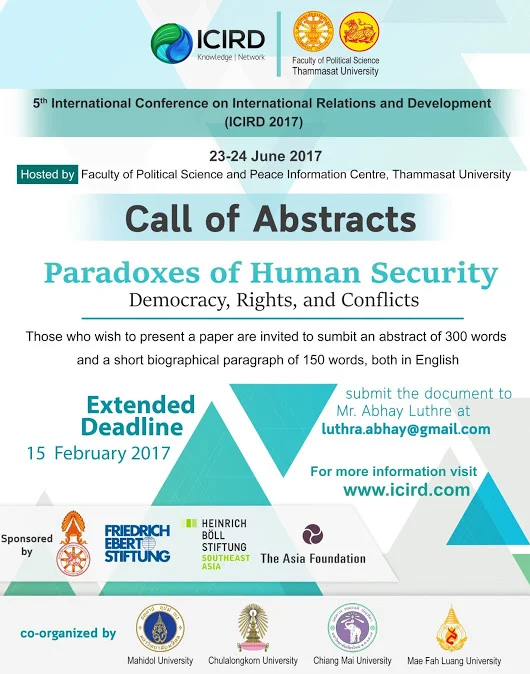
CONFERENCE: 5th International Conference on International Relations and Development (ICIRD) 2017, "Paradox of Human Security: Democracy, Rights, and Conflict" [23-24 June 2017]

08:00 - 18:15

Hosted by Faculty of Political Science and Peace Information Center, Thammasat University

Co-Organized by Faculty of Political Science, Thammasat University; Master of Arts Program in International Development Studies, Chulalongkorn University; Institute of Human Rights and Peace Studies, Mahidol University; Regional Center for Social Sciences and Sustainable Development (RCSD), Chiang Mai University; School of Social Innovation, Mae Fah Luang University


Over the past few decades, the concept of human security and policy implementation has constantly faced challenges and criticisms. Among others, the 9/11 attacks particularly persuade many that traditional (state-based) security should be at the core of international relations debates. These debates call for the mobilization of military efforts to curtail the widespread of global ‘terrorist cells’ at the expense of overlooking social, economic and political conditions that provide fertile ground for the acts of terror. Participants in these acts are often from the marginalized parts of the world where resources are monopolized by the local and global elite class. More importantly, they emerge from territories occupied by foreign powers whose collaboration with national leaders exacerbate the oppressive situation. Even though this is not the case for every ‘perpetrators,’ one can still argue that a crucial justification for their acts of terror originates in the globalised state of human insecurity – be it exploitation, inequality, prolonged civil war, and dismissed rights to express one’s identity.

It is necessary to bring back debates of human (in)security in connection with ongoing threats to state security. Without reviving this connection, it is unlikely that we would arrive at a comprehensive understanding as to why acts of terror have increasingly become the weapon of choice that has killed 30,685 lives in 2014 alone; what drove participants in cruel attacks in France, Belgium, Nigeria, Turkey, Pakistan, Iraq, Australia, Somalia, Lebanon and Indonesia; what are the justifications for the use of indiscriminate violence by fundamentalist groups; how civil wars have created waves of refugees; and how the failure in reforming global economy has precipitated economic disparity between the rich and the poor, and how this economic phenomenon is interpreted in a discourse of oppression that urges armed and unarmed resistance to it. Put differently, addressing and tackling the current state of global (in)security requires the understanding of the interwoven relationship of global peace, development, human rights and democracy.


Conference objectives

The International Conference on International Relations and Development (ICIRD) is one of the key activities organized within the framework of the ICIRD Knowledge Network.

The main objective of the conference is to provide a forum for debate between scholars, practitioners, civil society and community representatives on current development, international relations and human rights trends in Southeast Asia, with a particular focus or themes which differ from year to year. 
The International Conference on International Relations, Development and Human Rights (ICIRD) will held in Bangkok, Thailand, on 23-24 June 2017, which aims at engaging its participants in the discussion and debates which seek the relevance of different aspects of human (in)security with contemporary global issues, especially the current state of international security.

The International Conference on International Relations and Development (ICIRD) is one of the key activities organized within the framework of the ICIRD Knowledge Network.

The main objective of the conference is to provide a forum for debate between scholars, practitioners, civil society and community representatives on current development, international relations and human rights trends in Southeast Asia, with a particular focus or themes which differ from year to year. 
The International Conference on International Relations, Development and Human Rights (ICIRD) will held in Bangkok, Thailand, on 23-24 June 2017, which aims at engaging its participants in the discussion and debates which seek the relevance of different aspects of human (in)security with contemporary global issues, especially the current state of international security.


Conference themes

Scholars, researchers, graduate students, civil society organizations, governments and inter-governmental organisations representatives who work on the research and greater understanding of international relations, human rights and peace in the Asia-Pacific and beyond are encouraged to share their researches on the following areas:

CONFERENCE: "Knowledge Networks of Transdisciplinary Studies (KNOTS) Project Launch" [16 June 2017]

09:00 - 12:00, Alumni Meeting Room, 12th Floor, Building 3,

Faculty of Political Science, Chulalongkorn University


Background

The KNOTS project will focus on contemporary development challenges in Southeast Asia, where transdisciplinary research methods could offer novel insights and innovative solutions. The particular focus is on: environmental degradation; migration; and social inequality.

The KNOTS project will prepare curriculum and teaching/ learning materials on transdisciplinary methods to be integrated into each universities’ teaching programs. Three summer schools and fieldtrips will be organized in Vietnam and Thailand over the duration of the project to pilot and refine these materials. There will also be a Stakeholders Workshop in June 2017 and a final conference in 2019, to be hosted at Chulalongkorn University.

The three-year project was initiated in October 2016, and is a collaboration between seven universities in Europe, Thailand and Vietnam: the University of Vienna, Austria, which is also the project coordinator; Charles University, Czechia; University of Bonn, Germany; Chulalongkorn University and Chiang Mai University, Thailand; and Ho Chi Minh City Open University, Southern Institute of Social Sciences, and Vietnam Academy of Social Sciences, Vietnam.

The project is funded by the European Commission’s ERASMUS+ programme. At Chulalongkorn University, the MA in International Development Studies program is the project partner, alongside a network of academics and practitioners interested in teaching and practicing transdisciplinary research approaches.


Event objectives

This event will launch the KNOTS project at Chulalongkorn University. The objectives of the event are:

·         To formally launch the KNOTS project at Chulalongkorn University

·         To introduce the Chulalongkorn University team to the KNOTS project partners, and share about each team member’s institute/ department programs  


Agenda

9:00 – 9:20 Opening remarks

·         Assistant Professor Dr. Nunghatai Rangponsamrit, Assistant to the President for Research Development and Innovation (Social Science and Humanities)

·         Professor Emeritus Dr. Amara Pongsapich, Former Dean of the Faculty of Political Science and Representative of Faculty Promotion Committee on Social Science, Chulalongkorn University

·         Representative from European Union/ ERASMUS (t.b.c.)

9:20 – 9:40 Introduction to KNOTS project

·         Professor Dr. Petra Dannecker, Head of Department of Development Studies, University of Vienna

·         Assistant Professor Dr. Naruemon Thabchumpon, MA in International Development Studies program, Faculty of Political Science, Chulalongkorn University

9:40 – 10:00 Introduction to history of Chulalongkorn University

·         Emeritus Professor Dr. Supang Chantavanich, Adviser to the Asian Research Center for Migration, Chulalongkorn University

10:00 – 10:40 Brief introduction to institutes and programs of Chulalongkorn University

·         Faculty of Political Science: Assistant Professor Dr. Jakkrit Sangkamanee, Deputy Dean

·         Center for Social Development Studies: Assistant Professor Dr. Carl Middleton

·         Center for Peace and Conflict Studies: Dr.Vitoon Viriyasakulton, Deputy Director, Rotary Peace Center at Chulalongkorn University

·         Institute of Asian Studies: Assistant Professor Dr. Sukanda Lewis

·         Thai Studies program, Faculty of Arts: Assistant Professor Dr. Wasana Wongsurawat

·         Chulalongkorn University Social Research Institute (CUSRI): Dr. Sayamon Charoenratana  

·         Environment Development Sustainability (EDS) program: Dr. Naruemon Arunothai

·         Faculty of Science: Prof Dr. Wanida Jinsart, Dept of Environmental Science, Faculty of Science

·         Faculty of Engineering: Associate Professor Dr. Sucharit Koontanakulvong (t.b.c.)

10:40 – 11:20 KNOTS partners program introduction

·         University of Vienna

·         Charles University

·         University of Bonn

·         Chiang Mai University

·         Ho Chi Minh City Open University

·         Southern Institute of Social Sciences

·         Vietnam Academy of Social Sciences

11:20 – 11:30 Closing remark

NEWS: "MAIDS-CSDS Co-Working Space is now open!" [14 June 2017]

Welcome to MAIDS-CSDS Co-Working space located on the 2nd floor, Building 2, Faculty of Political Science, Chulalongkorn University. It is now open from 09:00 am. to 04:00 pm. Monday to Friday. 

Textbooks, previous theses, and researches are available to borrow. A coffee corner is coming soon!

This co-working space is open to all lecturers, researchers, staffs, and students as well as almuni of MAIDS and CSDS!

PUBLIC SEMINAR: "Web of Relations: The Way of Giving, Taking, Reciprocating in the Moken's World" by Dr. Narumon Arunotai [28 April 2017]

17884417_781659161998017_746157701867003737_n.jpg

14:30 - 16:30, Alumni Meeting Room, 12th Floor, Faculty of Political Science, Chulalongkorn University

Co-organized by Center for Social Development Studies (CSDS), Faculty of Political Science, Chulalongkorn University; IRASEC;

 Regional Center for Sustainable Development, Chiang Mai University (RCSD); and SASA

You are invited to join an upcoming public seminar on "Web of Relations: the way of giving, taking and reciprocating in the Moken’s world" by Narumon ArunotaiOn 28th April, 14:30-16:30 pm, Alumni Meeting Room, 12th Floor, Faculty of Political Science, Chulalongkorn University. This event is co-organized by Center for Social Development Studies (CSDS), Faculty of Political Science, Chulalongkorn University; IRASEC; Regional Center for Sustainable Development, Chiang Mai University (RCSD); and SASA

Posted by: MAIDS-Chula

PUBLIC SEMINAR: "The Politics of the 2011 Bangkok Floods" by Dr. Danny Marks [4 May 2017]

ดาวน์โหลด.jpg

10:00 - 12:00, Alumni Meeting Room, 12th Floor, Building 3, Faculty of Political Science, Chulalongkorn University

Co-organized by Center for Social Development Studies (CSDS), Faculty of Political Science of Chulalongkorn University, the Stockholm Environment Institute Asia Center, and Urban Climate Resilience Partnership in Southeast Asia (UCRSEA) at the Asian Institute, Munk School of Global Affairs, University of Toronto

You are cordially invited to the Public Seminar on "The Politics of the 2011 Bangkok Floods" by Dr. Danny Marks (UCRSEA Postdoctoral Research Fellow, Asia Institute, University of Toronto; and Research Associate, Center for Social Development Studies-CSDS, Faculty of Political Science, Chulalongkorn University.

When: 4 May 2017, 10.00 - 12.00
Where: Alumni Meeting Room, 12th Floor, Building 3, Faculty of Political Science, Chulalongkorn University

RSVP: salweenfellowshipprogram@gmail.com

Discussants: Dr. Nipon Poapongsakorn, Distinguished Fellow, Thailand Development Research Institute (TDRI) and Dr. Albert Salamanca, Research Fellow and Coordinator of Initiative on Transforming Development and Disaster Risks, Stockholm Environment Institute (SEI)

Moderator: Dr. Kasira Cheeppensook, Deputy Director, Center for Social Development Studies (CSDS), Faculty of Political Science, Chulalongkorn University

This event is co-organized by Center for Social Development Studies (CSDS), Faculty of Political Science of Chulalongkorn University, the Stockholm Environment Institute Asia Center, and Urban Climate Resilience Partnership in Southeast Asia (UCRSEA) at the Asian Institute, Munk School of Global Affairs, University of Toronto

This event is sponsored by International Development Research Centre (IDRC), Canada and Social Sciences and Humanities Research Council, Canada

Posted by: MAIDS-Chula