
Searching for the lost ontology: Tracing Balinese communities’ knowledge systems and evolutionary pathways
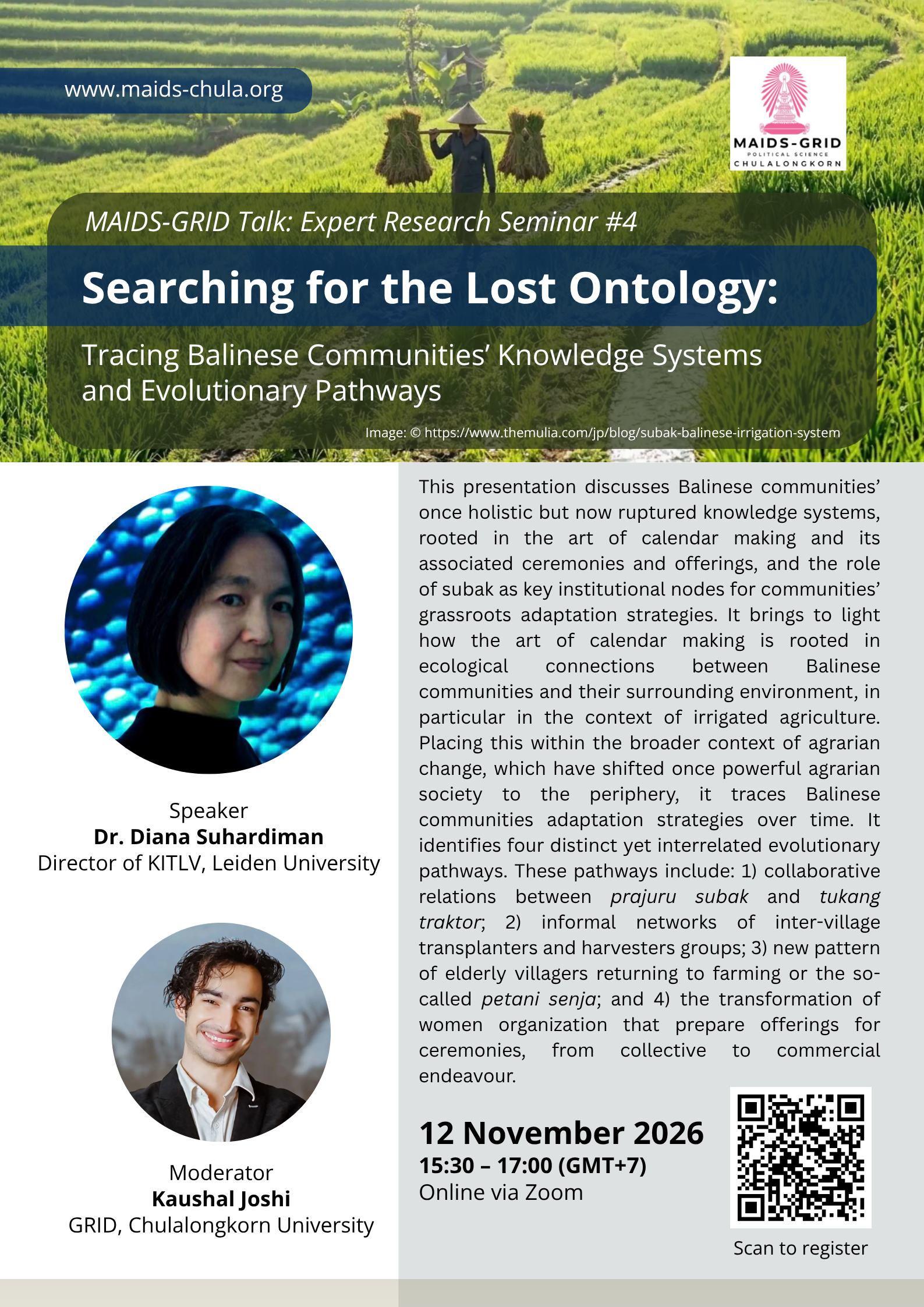
This presentation discusses Balinese communities’ once holistic but now ruptured knowledge systems, rooted in the art of calendar making and its associated ceremonies and offerings, and the role of subak as key institutional nodes for communities’ grassroots adaptation strategies. It brings to light how the art of calendar making is rooted in ecological connections between Balinese communities and their surrounding environment, in particular in the context of irrigated agriculture. Placing this within the broader context of agrarian change, which have shifted once powerful agrarian society to the periphery, it traces Balinese communities adaptation strategies over time. It identifies four distinct yet interrelated evolutionary pathways. These pathways include: 1) collaborative relations between prajuru subak and tukang traktor; 2) informal networks of inter-village transplanters and harvesters groups; 3) new pattern of elderly villagers returning to farming or the so-called petani senja; and 4) the transformation of women organization that prepare offerings for ceremonies, from collective to commercial endeavour.
Speaker
Dr. Diana Suhardiman
Diana is director of the Royal Netherlands Institute of Southeast Asian and Caribbean Studies/KITLV, an institute of the Royal Netherlands Academy of Arts and Sciences/KNAW. She is a professor of Natural Resource Governance, Climate and Equity (by special appointment) at Cultural Anthropology and Development Sociology, Leiden University. Putting power and politics central in the contemporary struggles of natural resource governance, she looks at policies and institutions (re)shaping governance structures, processes, and outcomes across scales (local to transboundary). Placing her research at the intersection of land, water, environmental, climate governance, she studies power struggles and processes of grassroots alliances shaping within the broader context of state transformation processes in various countries in Southeast Asia, including Laos, Indonesia, Myanmar, Thailand, Vietnam, and Cambodia.
Diana studied Tropical Land Use at Wageningen University (1998) and obtained her PhD in Social Science from the same university (2008). She has won several research grants, led various research programs, and served as a member of the editorial boards of Agriculture and Human Values and Leiden University Press, scholarly committees, both in the Netherlands and globally. Between 2016-2021, she was Research Group Lead Governance and Inclusion at the International Water Management Institute, based in Vientiane, Laos, where she also worked as post-doctoral fellow and later (senior) researcher since 2008.
She is the author of more than 75 publications, mostly journal articles, book chapters and monographs on the politics of exclusion, processes of contestation and institutional emergence in Southeast Asia, while placing natural resource governance within the broader context of socio-cultural and political landscapes.
Moderator
Kaushal Joshi
Kaushal Joshi is a PhD Candidate in the GRID program at Chulalongkorn University in Thailand. Originally from Nepal, his 7 years of academic and professional experience have taken him to diverse regions of the world including USA, Nepal, India, Thailand, and so on. Previously, he completed his Masters degree from the MAIDS program at Chulalongkorn University with a research thesis titled “Queer Tourism Development in Nepal: Building Inclusive Tourism through Rights-Based Approach”.
“MAIDS-GRID Talk: Expert Research Seminar” is an initiative conceived and managed by GRID Ph.D. students. It provides a dedicated space for experts from diverse fields to share insights on the multifaceted issues within development studies.
Venue and date:
Online via Zoom
Thursday, 12 November 2026, at 15:30 – 17:00 (GMT+7)
Scan the QR code to register or click the link below:
https://chula.zoom.us/meeting/register/q198bqw0RPueS7LuVv3Leg