Event

EVENT: "Field Trip to Map Ta Phut, Rayong" [3-4 November 2017]

Theme of the Study

"Development Cooperation between Public and Private Organizations on Industrialization and Local Adaptation to Its Current and Future Impacts"

assistant professor dr. carl middleton presented a gift to assistant director, map ta phut industrial estate and head of emcc

assistant professor dr. carl middleton presented a gift to assistant director, map ta phut industrial estate and head of emcc

visited environmental monitoring and control system in map ta phut industrial estate

visited environmental monitoring and control system in map ta phut industrial estate

visited closed-circuit television security network system office, map ta phut industrial estate

visited closed-circuit television security network system office, map ta phut industrial estate

Visited to Map ta phut industrial estate office, the industrial estate authority of thailand

Visited to Map ta phut industrial estate office, the industrial estate authority of thailand

Objectives of the Study

- To understand opportunities and challenges of economic development and industrialization under the Eastern Sea Board policy of the Royal Thai Government

- To understand the cooperation between public and private organizations in response to local livelihood in prior to the impacts of development

- To practice field research study in preparation for thesis writing

visited tapong community next to irpc company

visited tapong community next to irpc company

enjoyed the loy krathong festival

enjoyed the loy krathong festival

Introducing Map Ta Phut

Map Ta Phut  is a town in Rayong Province, Thailand. It is the site of Thailand's largest industrial park, the Map Ta Phut Industrial Estate. Provincial offices are in Map Ta Phut. According to the World Resources Institute, Map Ta Phut is "...one of Thailand's most toxic hot spots with a history of air and water pollution, industrial accidents, illegal hazardous waste dumping, and pollution-related health impacts including cancer and birth deformities.

a dinner discussion

a dinner discussion

The Map Ta Phut Industrial Estate is a large industrial park in the town of Map Ta Phut in Rayong ProvinceThailand. Part of Thailand's eastern seaboard economic region, it is the country's largest industrial estate and the world's eighth-largest petrochemical industrial hub. It was opened in 1990 and is managed by the Industrial Estate Authority of Thailand, a state enterprise under the Ministry of Industry.

Map Ta Phut houses five industrial estates, one deep-sea port, and 151 factories, including petrochemical plants, oil refineries, coal-fired power stations, and iron and steel facilities. The zone occupies 166 km2. The area contains around 30 agricultural and residential communities with more than 49,000 residents.

According to the World Resources Institute, "Map Ta Phut is one of the Thailand's most toxic hot spots with a...history of air and water pollution, industrial accidents, illegal hazardous waste dumping, and pollution-related health impacts including cancer and birth deformities."[1]:20

In 2007, 11 communities in the Map Ta Phut zone filed a lawsuit against the National Environmental Board (NEB), alleging that the board had improperly failed to designate Map Ta Phut and its vicinity a pollution control zone. Another lawsuit was filed against the NEB and eight other Thai ministries by community organizations. Managed by the Eastern People's Network, the lawsuit focused on the failure to follow prescribed procedures, including conducting environmental and health impact assessments, before issuing licenses to 76 new industrial projects. In 2009, the Supreme Administrative Court of Thailand suspended the development of 65 projects at the estate, worth an estimated US$8 billion, due to inadequate health impact assessments. It allowed 11 projects to proceed.[2] Ultimately, 74 of the 76 contested projects were allowed to continue.[1]:21

  • A 2012 explosion at the factory of a Bangkok Synthetics subsidiary killed 11 and injured another 129 people.[1]:21

  • A day following the Bangkok Synthetics explosion, a chemical leak occurred at the Aditya Birla Chemicals plant, leading to the hospitalization of 138 people.[1]:21

Source: Wikipedia

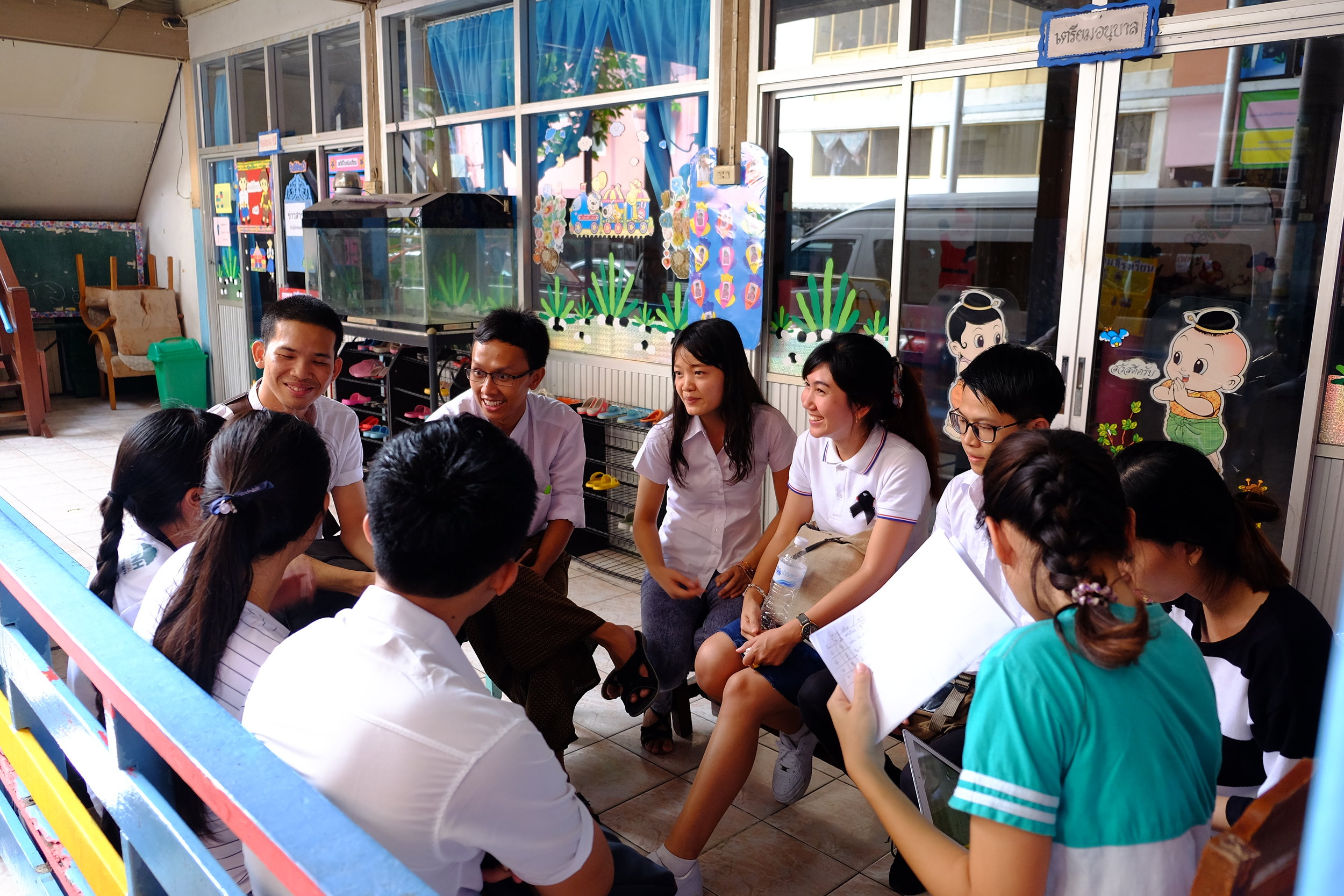
a final discussion after lunch for field trip summary and feedback

a final discussion after lunch for field trip summary and feedback

group 1 prepared their questions to the community member on industrialization and impacts to local livelihoods

group 1 prepared their questions to the community member on industrialization and impacts to local livelihoods

group 2 had a wonderful moment with the community member

group 2 had a wonderful moment with the community member

group 3 took a photo after their joyful interview with the community member (our key informant preferred anonymous)

group 3 took a photo after their joyful interview with the community member (our key informant preferred anonymous)

three valuable persons for our field trip

three valuable persons for our field trip


Acknowledgements

MAIDS-GRID Program would like to thank Ms. Penchom Sae-tang, Director, EARTH, on the local resource and personnel supports. We also fully regard a kind assistance from Khun Nid and Khun Tuk for their local coordination. Most importantly, we are enriched by the local community members whose knowledge are precious for our field visit. We wholeheartedly support their movement for community rights and environmental conservation.

EVENT: "Field Trip to Dear Burma" [10 September 2017]

Background of DEAR Burma

the Deputy Director, Mr. Myint Wai, gave introduction about DEAR Burma to MAIDS Students

the Deputy Director, Mr. Myint Wai, gave introduction about DEAR Burma to MAIDS Students

Mission

We work hard to help both male and female Burmese adults and children to integrate smoothly into their communities and at their jobs. Together, with our volunteer teachers, we operate the school to improve the lives of over 1.000 (and growing) students giving them the strength, confidence, and educational skills to have the same chances that their Thai counterparts have. Coming from insurmountable odds in their own country, often escaping to start a better life in Thailand and supporting their remaining family in Burma, the students attend the school on their own will. Due to the conflict in Burma, many of the students come from different ethnic groups such as Shan, Karen, Rakhine, Kayah, Mon, Kachin, Nepali, Padung and Indian and face the task of starting from nothing. No matter the background, all students wear a uniform of a white shirt and dark pants/shorts or skirt, bringing them all to an equal playing field and creating a sense of equality and mutual respect. The simple-but-progressive skills given to the thousands of students over the course of the 10 years Dear Burma has been in operation have changed the everyday lives of every one of them. One by one, student by student, Dear Burma is here to teach.

MAIDS Students asked questions about DEAR Burma School

MAIDS Students asked questions about DEAR Burma School

History

When the school first began operations in Sept 2002, classes were conducted in front of Ramkamhaeng University’s student club building, where they stayed for several months. The workers organised the classes themselves although it proved quite a hurdle to draw people at first. Refugees and activists also joined the classes eventually. In Feb of 2003 the Thai-Burma Coordinating Committee later decided the school should move to the Christian Students Centre in Bangkok and Myint Wai took the helm of the school. In May of 2005 they moved to the current location where they have remained up until now.

Thai Class at Dear Burma

Thai Class at Dear Burma


About the Deputy Director Myint Wai

Headmaster Myint Wai, 55, a former student who fled the military crackdown in 1988, has been a source of hope and offers help to fellow Myanmar citizens in need, including migrant workers. He graduated with a B.A. degree in economics from Yangon University and currently resides in Bangkok.

He attributes the success of the school to the wide range of assistance it gets, including help from organisations and political groups inside Myanmar, which have supported and monitored the work of the school. He has said, in reference to the school, that it is negotiating with both ministries to be recognised as a vocational training institute in Thailand.

MAIDS Students visited classes at DEAR Burma

MAIDS Students visited classes at DEAR Burma

Education

1.English

English is taught to the students on four levels:

Pre-Beginner 2 sub-levels

Beginner 4 sub-levels (L-1A to L-1D)

Elementary 3 sub-levels ( L-2A to L-2C)

Pre-Intermediate 3 sub-levels (pre-1 to pre-3)

After as few as one or two semesters many of the students gain the skill and confidence to hold a conversation in English. With their gained skills in English many are able to find jobs in numerous fields relating to tourism, sales, etc, giving them new hopes and ambitions.

2. Thai

There are 5 different levels of Thai language courses (Thai L-1 – Thai L-5). Some levels have as many as 10 classes and some with as few as 2.

With the hard work and dedication every student brings with them every week, after a bit of learning nearly every student can conversate and even find jobs in the Thai community. Also, being able to speak Thai helps protect them from being exploited, abused, or sent back to Burma.


Burmese

While Burmese is the official language of the country and the mother language of the Bamar, many of the students come from Shan State, Karen State, Chin State, and other remote areas where the language is not Burmese but rather their local language.

To better educate them and give them the opportunity to return to Burma to work in the future, or even to help them build relationships with other migrant workers living in Thailand, DEAR Burma offers Burmese language courses.


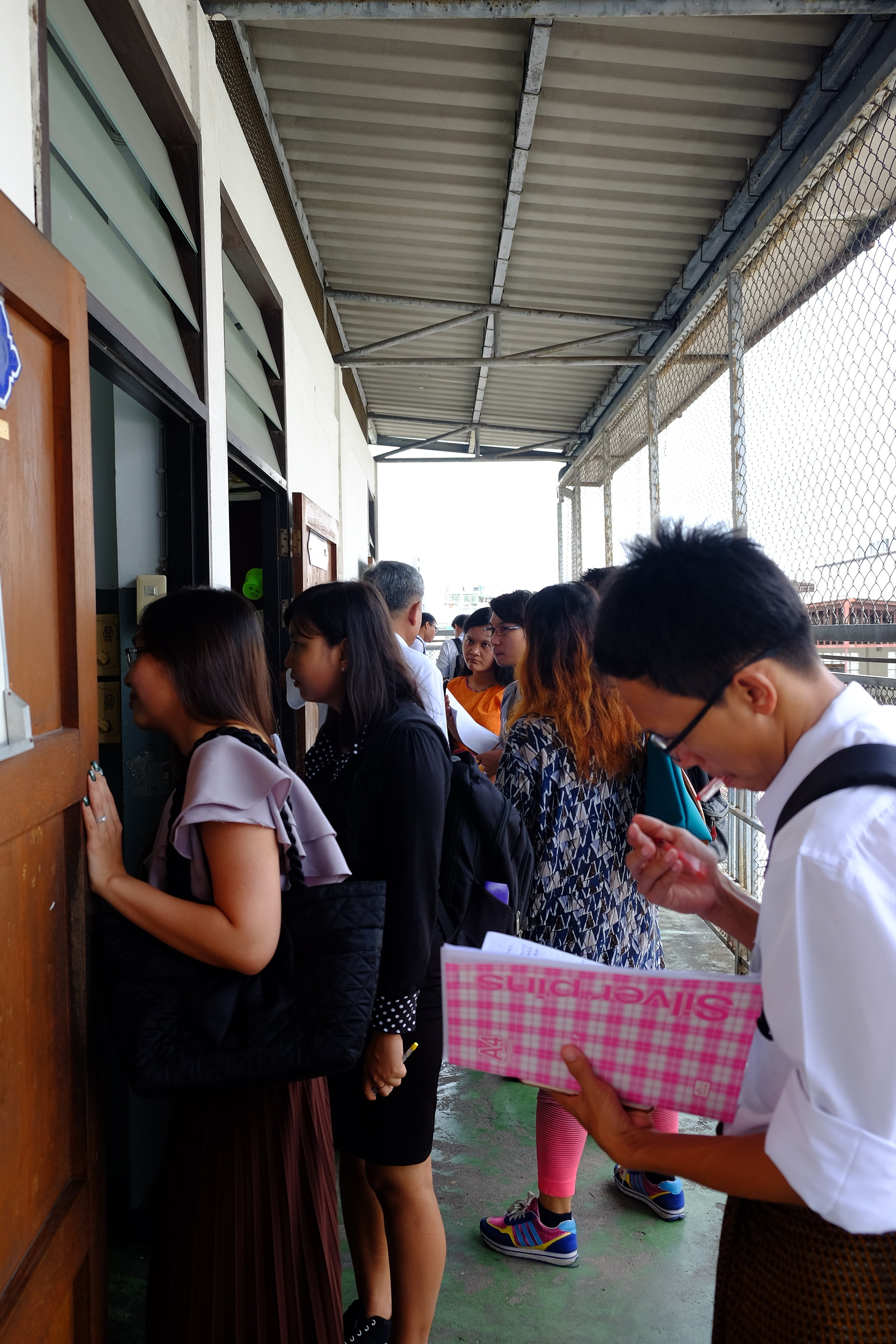
After Lunch MAIDS Students start interviewing Students at DEAR Burma

After Lunch MAIDS Students start interviewing Students at DEAR Burma

Others

As of late we have started to offer different courses to branch out and give more hope and opportunity to our students. We now offer computer courses, Photography, and other classes, as well as a fully stocked library with books in numerous languages.

EVENT: "Discovering Local Adaptation Strategies to Flooding: Third Pole Media Workshop Heads to Koh Kret" [22 August 2017]

Dr. Carl Middleton and Mr. Joydeep Gupta Greet and give some information about Koh Kret to the MAIDS Students and The Third Pole Journalists.

Dr. Carl Middleton and Mr. Joydeep Gupta Greet and give some information about Koh Kret to the MAIDS Students and The Third Pole Journalists.


Wasting no time, the group was then whisked away to a farming area, where a tour of a traditional fruit farm was given, allowing for a glimpse into Thailand’s agricultural practices and the challenges this sector now faces. Koh Kret island is famous for its durian fruit, which can cost up to THB 10,000 per kilogram. The farmer explained that whilst the durian trees are vulnerable to flooding, some farms build dykes to protect their trees, and there was a wider desire for more comprehensive flood protection dyke infrastructure for the whole island.

MAIDS Students enjoy wearing Thai traditional Costume 

MAIDS Students enjoy wearing Thai traditional Costume 

After a relaxing lunch alongside the river, the group broke up, with the MAIDS graduate students going off to practice some of their newly learned research methods and the journalists continuing their tour of the island, ending at the island’s famous pottery handicraft center, where traditional clay techniques were displayed and explained.

Story: Robert Irven / Photo: Nopakorn Paisarnmunkhong

Tucked away just north of Bangkok proper sits a tiny island on the Chao Phraya River, home to both local Thai and decedents of ethnic Mon communities who have shared this location for over 200 years. Koh Kret was the site of the second day of the CSDS/ MAIDS/ Third Pole media workshop, where our visiting journalists and new MAIDS students were taken for a day of observation and hands-on learning on 21 August 2017. Corresponding with the workshop’s main themes, the day focused on learning the island’s history and current responses to regular and severe floods, the utility of local/traditional knowledge, sustainable tourism and community cooperation and activism.  

Our group was first greeted and briefed by the islands main administrators, who gave a brief history of the island, and generously answered in detail many of the group’s questions relating to flood prevention and how urban and environmental changes were affecting the island. They emphasized a ranged of challenges, including river bank erosion, managing pollution, and the impacts of flooding.

representatives from Koh Kret Sub-district Administration Organization give a brief historical background of the island.

representatives from Koh Kret Sub-district Administration Organization give a brief historical background of the island.

After cooling off away from the brutal midday monsoon heat, the group arrived at the community center for some traditional Thai snacks and sweets, alongside an introduction of community life and how the seven moo’s [villages] interact and work together to keep traditions alive and teach its many daily tourists about their lives on Koh Kret.

Visit the Kret-buddha Garden to have  some Traditional Thai Snacks and local Fruit while Auntie Su speaks out on her life in the community in Koh Kret 

Visit the Kret-buddha Garden to have  some Traditional Thai Snacks and local Fruit while Auntie Su speaks out on her life in the community in Koh Kret 

Overall, the field trip to Koh Kret was an opportunity to learn firsthand the experiences of communities who regularly experience flooding of the Chao Phraya River. We discovered that whilst the floods are regularly disruptive, the communities and the local authorities collaborate together to prepare for floods as much as possible, and minimize the harm should flooding occur. Access to information is key to enable preparation, alongside a sense of community solidarity that ensures mutual support when flooding creates difficulties.

Dr. Carl Middleton presents some souvenir to the Koh Kret Sub District Administration Organization

Dr. Carl Middleton presents some souvenir to the Koh Kret Sub District Administration Organization